Emerald Ocean Engineering
|
Total Loss, Total Value, and Total
Confusion: The typical homeowners insurance policy for residences located in the coastal zone is the so-called “wind-only” policy; it covers damage caused by wind, and excludes coverage for damage caused by flood. Insurance coverage for flood damage can be purchased through a separate policy, usually one backed by the National Flood Insurance Program. However, much of the damage from hurricanes occurs in a zone where both wind and flood – in the form of storm surge – played a role, leading to what has been called the wind versus flood conflict. Courts have traditionally ruled under the concurrent causation principle that if two causes combine to produce loss or damage, and one of the two causes is excluded (e.g. flood) and the other cause is covered (e.g. windstorm), the loss will still be covered. Another principal, the doctrine of efficient proximate causation, is more specific. The entire loss is covered if an included cause is a substantial or predominant factor in the loss and it initially set any other causes in motion in an unbroken sequence leading to the ultimate loss. In response, many wind-only policies contain an anti-concurrent causation clause which excludes coverage for flood damage even if another covered peril or event contributed concurrently or in any sequence to cause the loss. The Valued Policy law has been applied to insurance contracts in many states for the last 100 years. Its intent is to assure that, in the event of the total loss of an insured property the calculation of indemnity was the same as used to collect the premiums – typically called the face value of the policy. In the famous 2004 Mierzwa case a Florida appeals court interpreted the Valued Policy law to mean that, in case of a total loss, the insurer must pay its full face value so long as there is any loss caused by an included cause. These various rulings and interpretations can result in any of four possible outcomes when an insured structure is a total loss due to concurrent wind and flood in a hurricane: 1. The loss is not covered at all if any portion
of the damage was due to flood, regardless of the sequence of the
wind damage with respect to the flood damage. As would be expected under such a cloud of confusion, the disastrous 2004 and 2005 hurricane seasons resulted in a flood of litigation. Both the courts and legislatures of coastal states responded in a attempts to clarify the issue. In Landry v. Louisiana Citizens Property Insurance Co, the Supreme Court of Louisiana ruled hat the Valued Policy Law does not apply when a different method of loss computation is provided in a policy. Furthermore, if the different method of loss computation is provide that clearly refers to covered loss, then the computation need only apply to losses from covered causes. The recent Mississippi Supreme Court ruling in Corban v. USAA Insurance Agency places the burden on an insurance company to demonstrate that, in order for an exclusion clause to apply, a loss was in fact due to an excluded peril, and furthermore, that it occurred prior to loss or damage from an insured peril. In 2005 the Florida legislature passed an amendment to the Valued Policy law that requires courts to determine whether “the covered perils alone would have caused the total loss.” If the property would not have been a total loss but for the loss caused by the covered peril, the Valued Policy law applies. Otherwise, “the insurer’s liability . . . shall be limited to the amount of the loss caused by the covered peril.” In 2009 the California Supreme Court (State of California v. Allstate) ruled that, 1) when a loss results from both included and excluded causes but the policyholder can’t allocate the amount of the losses between them, he is entitled to coverage of the whole loss up to the policy limits and 2) that the policyholder can’t be required to allocate those amounts. These various measures have tended to reduce the likelihood of option 1, wherein a homeowner receives nothing for his loss in spit of his intention to be insured, and option 4, wherein an insurer is forced to pay for a loss he specifically intended to preclude. However, they probably will not reduce the chance of litigation in cases of loss from concurrent wind and surge damage. If an insurer wishes to avoid paying policy limits, he assumes the burden of determining both the sequence and the pro rata amount of damage resulting separately from wind and flood forces. Thus the “wind versus flood” question has been transformed into “whence and how much wind versus flood.” Emerald Ocean Engineering has answered these two questions with precision and accuracy for over 60 properties in Mississippi and Louisiana damaged during Hurricane Katrina. Through a combination of hydrodynamic numerical models, wind and hydraulic force calculations, and structural analysis, it was possible to develop a timeline that demonstrated if and when damage to specific structural members occurred, separately, for wind and flood forces. No technical challenge to the results or methods was ever submitted and every case was settled prior to trial. There are many fallacies held by most people – including insurance adjusters - about the nature of hurricanes and storm surge, their interaction with structures, and the means of determining those impacts. Here are some facts. Fallacy - Surge and wind forces are
inseparable in a hurricane. Fallacy- Storm surge is a “wall of water”
that destroys everything in its path. Fallacy -Post storm high water marks are
reliable indicators of peak surge elevation. Fallacy - Allocating wind damage v. flood
damage is easy; all damage above the high water mark is due to wind and
all damage below it is due to flood. Fallacy - Peak winds occurred before the peak
of the surge; therefore, wind caused the damage before flood.
|
|
Time history of wind speed and surge level at a residence in Bay St Louis as Hurricane Katrina came ashore. The winds peaked at 115 mph at 10:00, and the surge reached nearly 25 ft one hour later. The top and bottom elevation of one wall is also plotted. |
|
Time history of wind and flood forces on one wall of a residence in Bay St Louis as Hurricane Katrina came ashore. Note that the wind force decreases as the wall is flooded. This wall failed by 8:00 when the force exceeded the capacity. |
|
Example current vector plot for a specific property overlaid on bathymetric/topographic contour map, from an EOE numerical model product |
|
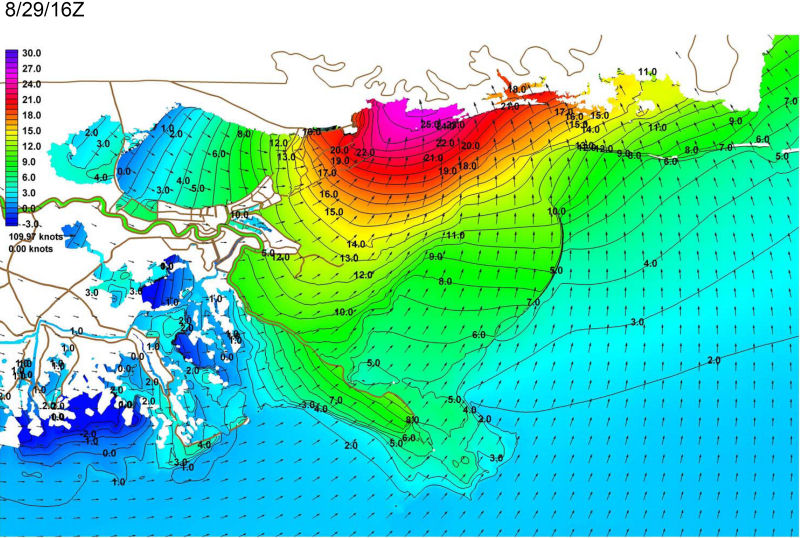
Example surge elevation contour plot of the MS LA coast as Katrina makes its second landfall, from the ADCIRC model run (IPET, 2006)
|