|
More Information: |
|
|
Small-Scale Living Shoreline for an Exposed, Rapidly Eroding Coast
|
|
|
Living shorelines are gaining favour as a sustainable response for
shoreline protection, but projects at exposed sites are often
impractical because of the significant breakwaters required to
control erosion and protect shoreline vegetation. The few that have
been built are usually large, expensive projects funded by
government agencies, such as Project Greenshores - the award-winning
living shoreline along Pensacola Bay designed by EOE. Small living
shoreline projects, on the scale of individual private lots, are
almost exclusively built at protected sites with very limited wave
exposure. In 2013 a client asked EOE to solve an erosion problem for
a rapidly eroding, exposed property on Mobile Bay, AL. Shoreline
retreat at this site had averaged over 2 ft/year since 1997, but the
owner wanted to avoid the unwanted consequences of a hard bulkhead
or revetment, which include impacts to neighbouring properties and
loss of a recreational beach. The novel feature of this project is a
broad-crested, offshore submerged breakwater/oyster reef that
provides wave protection for the salt marsh near the shoreline. The
project was constructed in the summer of 2014 at a cost competitive
with traditional “hard” solutions and is undergoing a 3-year post
construction monitoring program. To date, the design has been
successful at controlling erosion without the usual deleterious
effects, while providing a valuable recreational beach for the
homeowner.
Client:
Reports:
McGehee, David D., 2016 "Design and
Monitoring of a Small Living Shoreline Scaled for Private Properties
on Exposed, Rapidly-Eroding Coasts," 6th
International Symposium on Hydraulic Structures, USDD and IAHR,
Portland, OR, 27-30 June, 2016
McGehee, David D., and Kirschenfeld, T., 2015,
"Downsizing a Living Shoreline;
Retail-scale Options for Private Properties on Exposed,
Rapidly-Eroding Coasts," National Coastal Conference,
American Shore and Beach Preservation Association, New Orleans, LA,
16-18 Oct, 2015
McGehee, David D., 2013, “Design Analysis Report for Living
Shoreline on (Point Clear, AL) Property,” Contractor Report to
Verazo and Kirschenfeld, Emerald Ocean Engineering LLC, Pensacola,
FL, October 28, 2013
McGehee, David D., 2013,”Site Analysis Report for (Point Clear, AL)
Property,” Contractor Report to Verazo and Kirschenfeld, Emerald
Ocean Engineering LLC, Pensacola, FL, July 15, 2013
|
|
 |
 |
|
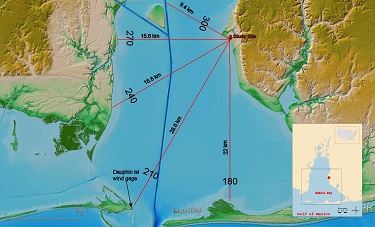
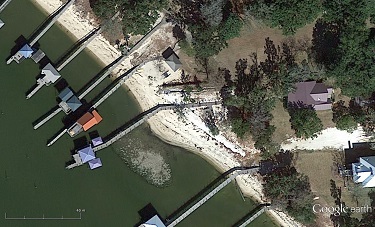
The project site is exposed to significant waves due to the 29 km fetch to the southwest (left). Aerial view of the project 6 months after construction (right) shows the submerged reef at extreme low tide. The reef is designed to function in winds up to 40 knots and survive hurricane conditions without damage. Note the naturally occurring salient (bulge) in the lee of the reef. |
|
 |
 |
|
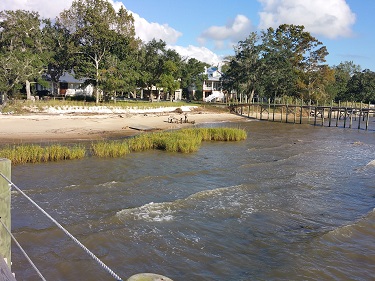
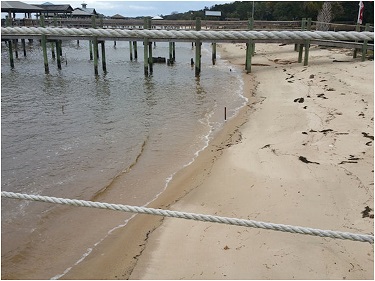
Project shoreline 18 months after construction at high tide shortly after experiencing a storm that exceeded the design conditions (left). Note the persistence of the salient and of the vegetated berm at the backshore. At right is a view looking downdrift at the adjacent property; the lack of localized erosion shows that sediment transport continues behind the reef. |
|
 |
 |
|
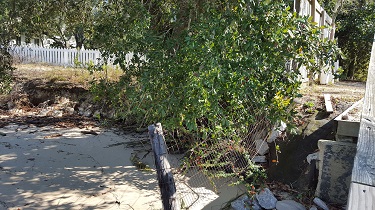
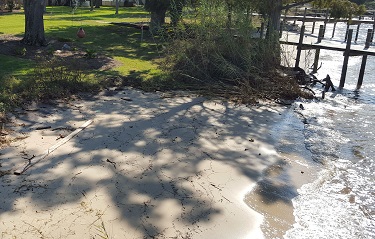
Nearby properties, both protected (l) and unprotected (r), did not fare as well during the same storm. |
|
 |
|
|
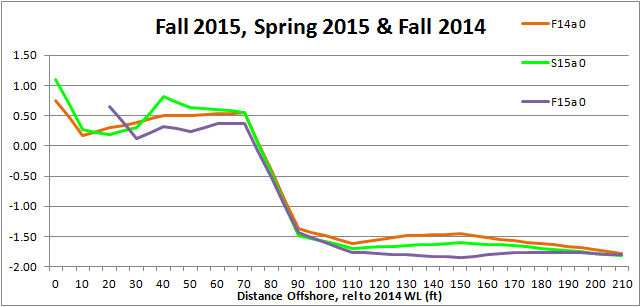
Semi annul surveys show that even though the reef has adjusted dynamically, losing a few inches of elevation, the shoreline behind it has accreted about 20 ft since construction. |
|
|
|
|